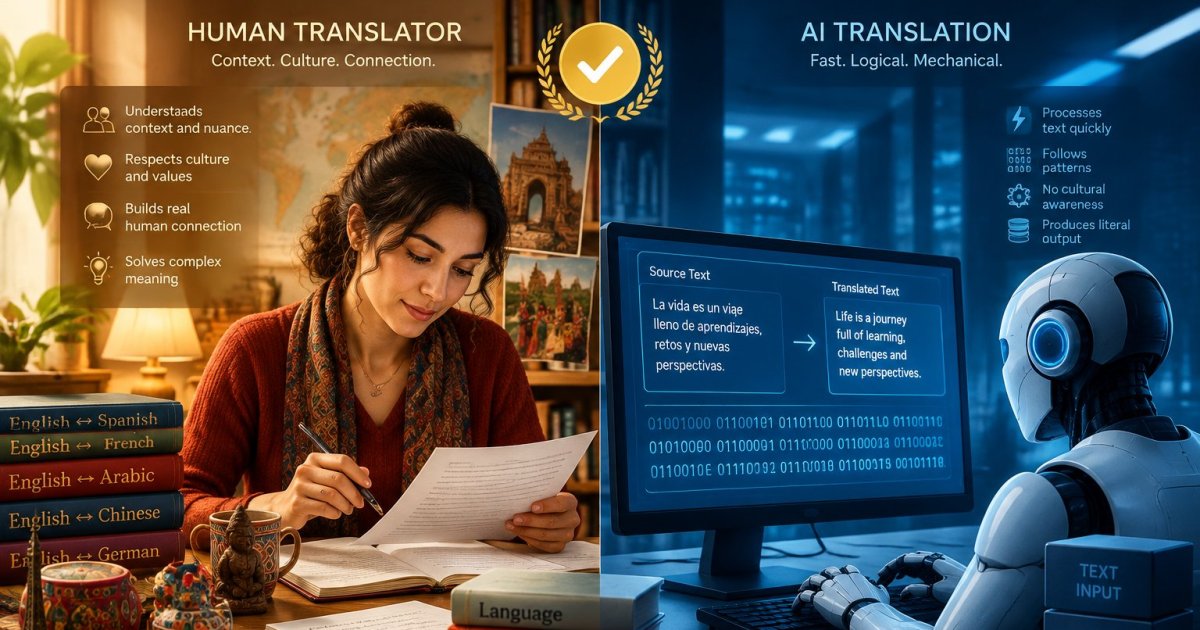
When accuracy, clarity and cultural understanding truly matter, professional human translation provides a level of quality that technology alone cannot achieve.
Artificial intelligence has transformed the way we communicate. From translating short phrases online to generating entire documents in seconds, AI-powered language tools are now widely available and often appear to offer a quick solution.
However, at Romo Translations, we believe that translation is about far more than replacing one word with another. Every document has a purpose, every audience has different expectations, and every language carries its own cultural identity.
That is why our professional human translators carefully consider meaning, tone and context to ensure every translation reads naturally and communicates exactly what the original author intended.
Language Is About Meaning, Not Just Words
One of the biggest misconceptions about translation is that it simply involves finding equivalent words in another language. In reality, language is shaped by culture, history, local customs, emotions and social expectations.
The same sentence can have different meanings depending on who is speaking, who is reading it and why it has been written. A marketing slogan needs to persuade, a legal document must be precise, a medical report has to be completely accurate, and a website should feel natural to local readers.
Professional human translators understand these differences instinctively. They don't simply translate vocabulary; they interpret the message behind the words.
This ability to understand intention is something AI cannot genuinely replicate. Whilst AI analyses patterns from enormous amounts of data, it does not understand culture, emotion or human experience in the way people do.
Context Makes Every Translation Different
Words rarely exist in isolation. Their meaning depends on the surrounding text, the subject matter and the intended audience.
Take a simple word like "charge". Depending on the context, it could refer to:
- Paying for a service
- An electrical current
- A criminal accusation
- Leading an attack
- Charging a battery
A human translator recognises the intended meaning immediately because they understand the wider context. AI can often identify the correct option, but it can also make confident mistakes that are difficult to spot because the finished sentence still appears fluent.
This is one of the greatest risks of relying solely on machine translation. It often sounds convincing even when the meaning has shifted.
Culture Cannot Be Automated
Every language reflects the culture of the people who speak it.
Humour, politeness, idioms, traditions and even sentence structure vary from country to country. What feels friendly in one language may sound overly formal in another. A phrase that works perfectly in English may confuse readers elsewhere or even cause offence.
Professional translators understand these cultural differences because they work with language as people actually use it.
Rather than producing a literal translation, they adapt the content, so it feels completely natural to the target audience while remaining faithful to the original message. This process, often known as localisation, helps businesses communicate effectively across international markets and build trust with customers from different cultural backgrounds.
Tone of Voice Is Just as Important as Accuracy
Every piece of writing has its own personality.
A luxury brand needs sophisticated language. A charity campaign should sound compassionate. A legal contract demands absolute precision, whilst a website needs to be engaging, approachable and easy to read.
AI can imitate different writing styles, but it does not truly understand why a particular tone has been chosen or how subtle changes affect the reader's perception.
Professional translators carefully preserve your brand's voice, ensuring your message remains consistent across every language. This is particularly important for businesses that rely on strong branding and customer relationships.
Why Human Review of AI Isn't the Same as Human Translation
Many organisations now use an "AI first, human checked" approach, believing it combines the best of both worlds. Whilst this may sound efficient, it often creates additional challenges rather than improving quality.
When a professional translator receives AI-generated content, they are no longer creating a translation from the original source. Instead, they are identifying errors, correcting awkward wording, restoring missing meaning and checking whether the AI has misunderstood the context.
This process is known as post-editing, and it requires a very different mindset.
The translator must constantly compare the original document with the AI version, identify subtle inaccuracies and decide what needs rewriting. Research and industry experience show that this can take almost as much time as translating from scratch, particularly for complex, technical or creative content.
At Romo Translations, we believe it is always better to create meaning from the original document rather than spend time repairing wording that was never fully understood in the first place.
Accuracy Builds Confidence
Translation errors can have significant consequences. An incorrect instruction could create confusion. A poorly translated marketing campaign may fail to connect with customers. Errors in legal or financial documents can lead to misunderstandings, delays and unnecessary costs.
Professional human translators bring more than language skills to every project. They combine subject knowledge, cultural understanding and careful attention to detail to ensure your message is accurate, appropriate and fit for its intended purpose.
This level of quality gives businesses confidence that their communications represent them professionally in every language.
AI Has Its Place, But Human Expertise Leads the Way
Artificial intelligence is undoubtedly a valuable tool. It can help with research, provide rough drafts, assist with repetitive tasks and support everyday communication where absolute accuracy is not essential.
However, there remains a clear distinction between generating words and genuinely understanding language.
Human translators understand humour, emotion, regional differences, audience expectations, implied meaning and cultural references because they are interpreting communication through lived experience, not statistical prediction.
That difference becomes increasingly important whenever reputation, compliance, customer trust or business success depends on the quality of the translation.
Professional Translation You Can Trust
At Romo Translations, we combine linguistic expertise with cultural awareness to deliver translations that are accurate, natural and tailored to your audience.
Whether you require business documents, legal paperwork, technical manuals, websites, marketing materials or certified translations, our experienced translators work directly from the original text to ensure every nuance, intention and message is communicated clearly.
While AI will continue to evolve and play an increasingly useful role in supporting language services, it cannot replace the human understanding that sits at the heart of effective communication.
Because great translation isn't simply about changing words into another language. It's about ensuring your message is understood exactly as you intended, wherever in the world your audience may be.